
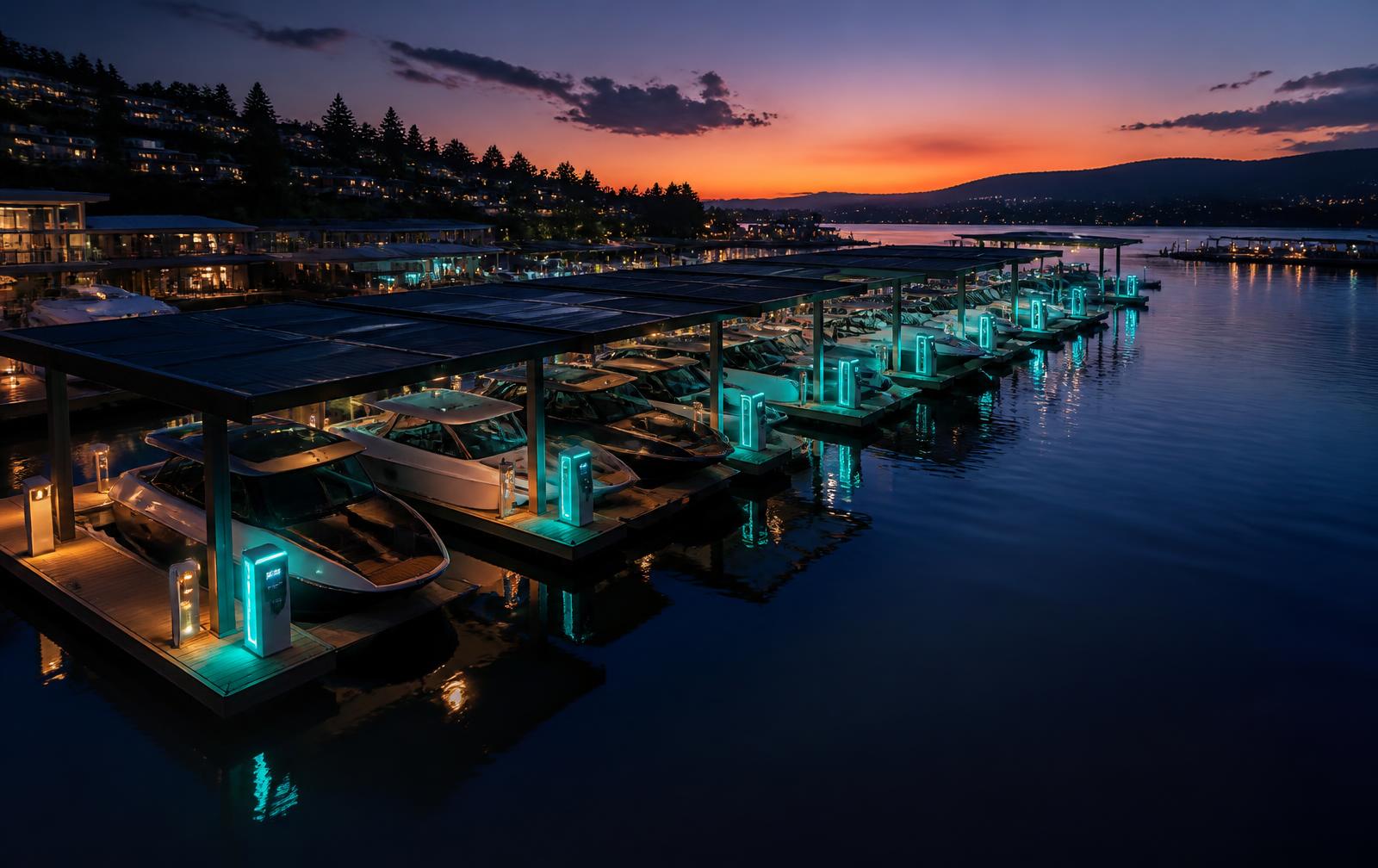
Lower marina power costs. Keep critical systems running.
GridLynQ installs and operates battery storage and modern shore power sized to your property, from 0.5 MW. Under the Host lease there's no upfront cost to you.
- Cut peak-demand charges on your power bill.
- Keep critical loads running during outages.
- Earn from eligible grid programs as they open.
What you get
What works today, and what comes next.
Available now
- • Battery storage
- • Peak-demand savings
- • Backup power for critical loads
- • Shore-power upgrades
As your utility allows
- • Grid-service programs
- • Electric-boat and RV charging
In development
- • Boats and RVs feeding power back (V2G)
- • Tax-credit marketplace
No GridLynQ site is operating yet. Grid programs and V2G depend on your utility and equipment.
How you benefit
Where the money comes from.
A battery on your site charges when power is cheap and runs during your busiest hours, so your utility bills you for a lower peak. Where your utility allows, it can also earn from grid programs.
Host lease
- • You pay nothing upfront. GridLynQ owns, insures, maintains and replaces the battery.
- • Your power bill drops from day one as the battery cuts your peak-demand charges.
- • Once the system has paid for itself, you also receive a share of what it earns from grid programs.
- • 20-year term with renewals.
Licensed Host
- • You buy the battery, with financing available from independent lenders.
- • You keep the bill savings and grid-program earnings.
- • GridLynQ provides the platform, engineering and support for a licence fee.
- • Best if you want ownership and the full upside.
Your exact share and fees are set in your private proposal after the site review.
Case study · rate-table examples
The same marina, four different power bills.
A sample 120-slip marina modelled under assumed rates in Massachusetts, Maine, California and Hawaii. Demand charges drive most of the difference.
Test case for a potential pilot. Not a site we hold, not a customer, and not a measured result — every figure is model output from the assumed conditions stated here.
| State | Assumed energy rate | Assumed demand charge | Modelled annual savings |
|---|---|---|---|
Massachusetts Assumed commercial general-service tariff, investor-owned utility | $0.30/kWh | $18/kW-month | $4,000 – $7,000 Modelled, not measuredActual host benefits depend on site load, utility rates and program availability, and are confirmed after a site review. |
Maine Assumed small/medium commercial tariff, coastal service area | $0.24/kWh | $14/kW-month | $3,000 – $6,000 Modelled, not measuredActual host benefits depend on site load, utility rates and program availability, and are confirmed after a site review. |
California Assumed commercial time-of-use tariff with demand charges | $0.33/kWh | $28/kW-month | $7,000 – $12,000 Modelled, not measuredActual host benefits depend on site load, utility rates and program availability, and are confirmed after a site review. |
Hawaii Assumed commercial tariff, island grid | $0.42/kWh | $25/kW-month | $6,000 – $10,000 Modelled, not measuredActual host benefits depend on site load, utility rates and program availability, and are confirmed after a site review. |
Assumptions used
- • 120 slips at 0.9 kW per slip → about 108 kW billed peak
- • Battery shaves 20–35% of the monthly peak
- • 22 peak events a month, 2 hours each
- • 88% battery round-trip efficiency; losses charged at the energy rate
- • Savings = demand charge relief minus battery losses, rounded to $1,000
What this is not
Rates are assumed planning values for illustration, not quotes of any utility's current tariff. No solar, grid-program or revenue-share income is included. Modelled figure. Produced from stated assumptions about site conditions, tariffs and utilisation, not measured from an operating hub. Your own bill replaces every one of these figures.
What's real today
Who we are, and where the pilot stands.
Team
Kyle Ritchie, Chief Executive Officer, GridLynQ Inc. Kyle came from the water and has built electric boats.
Read our storyDelivery partners
Engineering, procurement and installation partners are in discussion. We name a partner here only once an agreement is signed.
Sample engineering assessment
Sample — not a real siteWhat your site review covers:
- Peak demand
- Read from 12 months of bills
- Critical loads
- Pumps, fuel dock, lighting, office kept on in an outage
- Space & layout
- Where the battery sits, setbacks and flood level
- Electrical service
- Switchgear, pedestals and upgrade needs
- Utility programs
- Demand-charge rules and grid programs open to your site
- System size
- From 0.5 MW, sized to your load
Pilot milestones
Target dates for the first marina sites. No GridLynQ site is operating yet.
1. Apply
By 31 March 2027
Deliverable: Your site details and a preliminary fit check
Moves on when: Site looks like a fit and you agree to a site review
2. Site review
Q2 2027
Deliverable: Engineering assessment: load, space, electrical service, utility rules
Moves on when: You choose Host lease or Licensed Host and sign the NDA
3. Proposal & agreement
Q2 2027
Deliverable: Private proposal with your exact numbers
Moves on when: Signed agreement and utility application filed
4. Engineering & permits
Q2–Q3 2027
Deliverable: Stamped design, permits, equipment ordered
Moves on when: Permits issued and equipment delivered
5. Build
Q3 2027
Deliverable: Battery, shore-power upgrades and controls installed
Moves on when: Utility inspection passed
6. Go live
Q3 2027 target
Deliverable: Commissioned system and first monthly report
Moves on when: Ongoing operation and savings reporting
2-minute check
Is your property V2G-eligible?
A few questions about your property type, slip and site count, electrical service and goals. You'll get a tailored build recommendation before you talk to anyone.
Step 1 of 8
What kind of property do you operate?
Step 4
Request your free site review
Questions
Straight answers for operators.
Do our tenants need new boats or RVs?
No. GridLynQ hardware charges any standard vessel or rig today, and adds bidirectional capability for the growing share of V2G-capable batteries. The site is future-proofed on day one and earns charging revenue immediately.
Will discharging drain a customer's battery?
Owners set floor limits and departure times. Dispatch never crosses the reserve they choose, and every kWh exported is logged and credited back to their account.
What does it cost to install?
We offer both owner-funded builds and revenue-share deployments where GridLynQ funds the hardware and shares program earnings. The site audit determines which fits your electrical service.
Does this work at seasonal or off-grid campgrounds?
Yes. Full-time and long-stay sites are the strongest V2G candidates because rigs stay connected. Transient loops still earn on metered charging, and solar or storage can be paired where the service is thin.
Not a marina? Boat storage · RV parks · Cold storage — investors, partners and press are in the menu.